
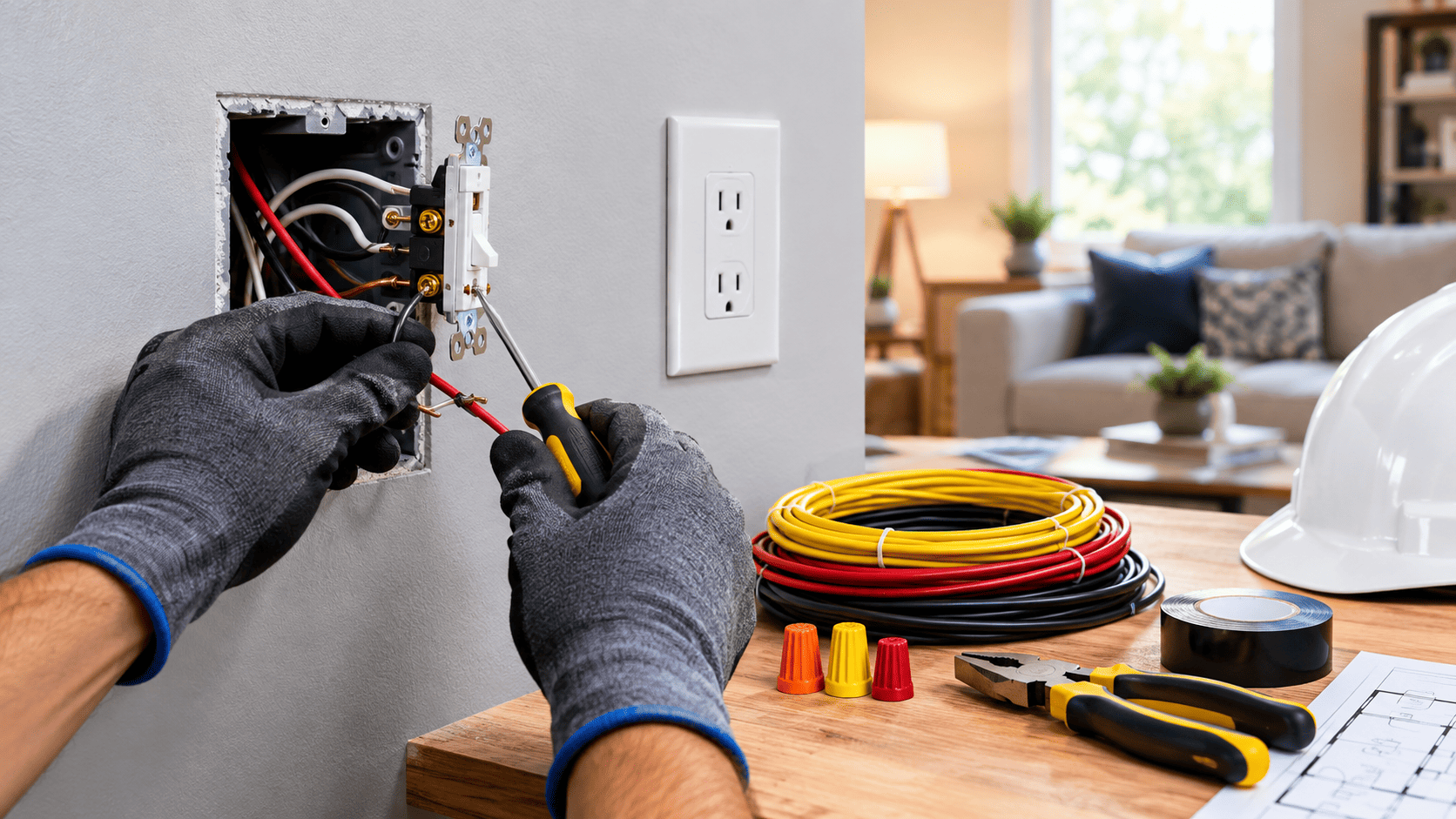
Essential home electrical wiring involves understanding wire gauges, wire color codes, and ensuring proper GFCI protection according to common safety standards. Understanding home electrical wiring basics requires knowing wire color codes, basic circuit paths, and safety precautions. Knowing an electrical wiring guide helps homeowners to protect themselves from shocks or home fires, fix minor issues like replacing switches, and talk clearly with licensed electricians.
Wire Color Codes
- Hot Wires
Black or Red insulation indicates ungrounded current-carrying conductors. These carry current from the main panel to the outlet.
- Neutral Wires
White or Gray insulation identifies grounded current-carrying conductors. These carry current back from the device to the main panel to complete the working loop.
- Ground Wires
Bare copper or green insulation is strictly reserved for equipment grounding. It gives electricity a safe path to the Earth if a fault or short circuit occurs. This prevents you from severe shocks.
Common Circuit Types
Electricity flows from a service panel through hot wires, powers a device, and returns via neutral wires.
- Branch Circuits
Single paths that leave the breaker box to power lights and wall outlets in specific rooms.
- Dedicated Circuits
Separate direct paths made for one heavy appliance like an oven or clothes dryer.
- Switch Loops
A special path that sends hot power to a wall switch and back to a light fixture.
Decoding the Jacket: Gauge and Sheathing 101
Wire Gauge
Gauge measures the physical thickness and current capacity of a wire. It is a standard size measurement (like AWG) for the metal conductor’s diameter. A lower number means thicker wire carrying more power. A higher number means a thinner wire for low power.
Common Residential Wire Sizes and Uses
US residential wiring uses the American Wire Gauge System (AWG); the larger the AWG number, the smaller the physical size of the wire.
| AWG Size | Rated for | Used For |
| 14 White jacket | 15-amp circuits | General lighting, bedroom outlets. |
| 12 Yellow jacket | 20-amp circuits | Kitchens, bathrooms, and general-purpose receptacles. |
| 10 Orange jacket | 30-amp circuits | Clothes dryer, water heater. |
| 8 | 40-amp circuits | Cooktops, large electrical ranges. |
| 6 | 50-amp circuits | Large electric ovens, subpanels. |
| 2 or3 | Used for main 10-amp to 200-amp residential circuits entrance feeds. | |
Sheathing
Sheathing is the tough outer protective coating (plastic or metal jacket) that groups or protects multiple insulated wires (hot, neutral, or ground) inside a cable. It guards the inner wire from physical damage, moisture, and heat.
Common types of home electrical wiring include
- NM Non-Metallic wires
Popularly known as ROMEX, it groups hot, neutral, and ground wires inside a flexible plastic jacket for inside dry home walls.
- UF (Underground Feeder)
Solid plastic jacket built for damp or buried outdoor paths, lights, and detached garages.
- Armored/Metal Clad
It wraps insulated wires in a steel sheath to guard against sharp tools or structural damage.
| The 6-12 Rule in electrical wiring, defined in NEC article 210.52 of the National Electrical Code, mandates that no point along a floor line in any wall space can be more than 6 feet away from a receptacle. Outlets must be spaced a maximum of 12 feet apart. |
House Wiring Safety Tips
Nearly 7 children go to emergency rooms daily for electrical shock or burn injuries from tampering with wall outlets.
- Always turn off the switch at the main service panel (breaker box) and test the wires with a non-contact voltage tester before touching them.
- Use only one heat-producing machine per wall socket.
- Plug large appliances straight into the wall.
- Keep extension cords for temporary use only.
- Never yank the cord. Pull from the plug.
- Match the light bulbs wattages strictly to fixture labels.
- Install GFCI outlets in moisture-prone areas like bathrooms, kitchens, laundry rooms, and outdoor spaces to prevent shock.
- Tamper-resistant outlets are mandated in all US residential construction starting with the 2008 NEC to prevent child injuries.
Signs of bad wiring include
- Circuit breaker trips
- Flickering lights
- Warm switch plates
- Discolored outlets
- Buzzing sounds near walls
- Mild tingle when touching an appliance
Mistakes to Avoid
Older homes often lack grounded three-prong outlets and adequate amperage capacity for modern digital and appliance load. Putting smaller wires on larger breakers creates a severe fire hazard. The wire can overheat before the breaker trips.
Avoid common mistakes like
- Skipping electrical diagrams
- Poor switchboard placement
- Cutting horizontal wall chases
- Using undersized wire gauges
- Selecting low-quality conduits or wires
- Mixing conductor sizes
- Leaving loose connections
- Ignoring proper earthing
- Upsizing circuit breakers improperly
- Unprotected or hidden splices
| The NEC is updated every three years to mandate new safety technologies like arc-fault and temperature-resistant protection. |
Conclusion
Knowing electrical wiring basics can help spot minor issues before they cause fires. Homeowners can safely do minor tasks like replacing standard wall switches or light fixtures. Call a licensed electrician for electrical panel upgrades, adding new high-load electrical circuits, dealing with aluminum wiring, or fixing persistent breaker tripping.
From wiring and panel upgrades to troubleshooting and emergency repairs, Jerizen Electric is available 24/7, offering precision and licensed care for long-term reliability.
FAQs
What do the different wire colors mean?
Black and red wires are hot, carrying current. White wires are neutral, returning current. Green or bare copper wires are for grounding.
What gauge wire do heavy appliances need?
Heavy appliances typically require 10 gauge to 6 gauge copper wires, depending on their total power draw. Standard choices match the electrical load: 10 gauge for 30-amp units, 8 gauge for 40-amp heavy loads, and 6 gauge for high-capacity mains.
What are the main wiring types in a home?
The main wiring types include NM (non-metallic) cable, AC (armored) cable, conduit systems, low-voltage wire, and specialized appliance wires like coaxial and data cables.